
Indian and American experts on Wednesday held detailed discussions on a range of implementation issues, including administrative, liability, technical and licensing matters to advance the operationalisation of Indo-US civil nuclear cooperation that has been in limbo for past 9 years.

Menon clarified that there were no conditions attached with the deal.

India and Canada solidify their partnership with a landmark uranium supply agreement and discussions to finalise a comprehensive economic partnership, signaling stronger ties and cooperation on key global issues.
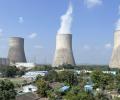
In a significant move, the United States on Wednesday removed restrictions on three Indian nuclear entities, over a week after National Security Advisor Jake Sullivan announced that Washington was finalising steps to 'remove' hurdles for civil nuclear partnership between Indian and American firms.

External Affairs Minister S Jaishankar and US Secretary of State Marco Rubio discussed cooperation in trade, critical minerals, nuclear energy, and defence, reaffirming commitment to a free and open Indo-Pacific.
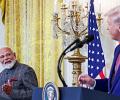
Prime Minister Narendra Modi and US President Donald Trump have vowed to move forward with plans to work together to build US-designed nuclear reactors in India. The decision was made during their meeting at the White House, where they also agreed to significantly expand energy cooperation. The move comes after India announced plans to amend its nuclear liability law and the Atomic Energy Act, which had previously been obstacles to the implementation of the US-India civil nuclear deal.
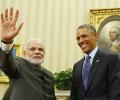
With their landmark 2005 civil nuclear deal still in limbo, India and the United States have established an inter-agency contact group to sort out outstanding liability and technical issues to fast-track its full implementation.
Emphasising that the reprocessing right was "absolutely necessary" for India, Mukherjee maintained that the government would not like the nuclear cooperation agreement to have any impact on the country's indigenous strategic programme.
Cornyn said he was hopeful that the full Senate will pass the agreement by the year end.

As the Under Secretary for Commerce, Juster played a key role in developing the Indo-US deal.
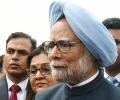
Condolences have poured in from across the globe, including from the United States, Canada and Sri Lanka following the demise of former Prime Minister Manmohan Singh.

India is expected to strongly push for a bilateral totalisation agreement with the US during President Barack Obama's visit later this month.

Ron Somers, founder and CEO of India First Group and the former President of leading business advocacy group US-India Business Council said that when Lok Sabha election results are declared on June 4, "I believe that Narendra Modi will win Parliament by the largest majority ever recorded in the country's history.

"A Biden administration will be mostly positive for India," said Rick Rossow from the Centre for Strategic and International Studies think tank. "I expect most positive areas of cooperation -- notably defence -- to be maintained," he said.

Jimmy Carter, the 39th US president and a champion of peace and human rights, has died at the age of 100. Carter, who was known for his work with the Carter Center, promoting democracy and conflict resolution, was also a close friend of India. He visited the country in 1978, forging a lasting relationship between the two nations.

Kerry said Obama has called the relationship with India 'a defining relationship of this century'.

The landmark civil nuclear deal sealed on Friday with Japan is strikingly similar to the agreements India has with the US and some other countries but contains some added features on safety and security, reflecting Japan's concerns on the issue.
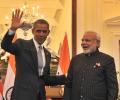
Decisions taken during the meeting of Prime Minister Narendra Modi and US President Barack Obama will take the bilateral strategic ties to an "altogether new high", India Inc said.
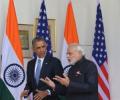
It is for the companies and the industry to ascertain where they want to run with the US-India civilian nuclear agreements reached by Washington and New Delhi, says United States Assistant Secretary of State Nisha Biswal. Aziz Haniffa reports for Rediff.com from Washington, DC

'Of all the areas that define the future for a strong US-India partnership, none is more important than our defence and security ties.'

On the final day of Prime Minister Narendra Modi's visit to the US, that country on Tuesday extended its Defence Cooperation Agreement with India by another 10 years. The pact, which was to expire in June next year, will now be in force till 2025.

Reports (not denied by India) that the USA had 'for the first time provided real-time details to their Indian counterparts on the Chinese positions and force strength in advance of a PLA incursion' into Tawang at the LAC in December 2022, helping India thwart China's expansionist designs, show how operationally effective the USA-India friendship has become on the ground. A engaging excerpt from Sreeram Chaulia's must-read new book, Friends: India's Closest Strategic Partners.

Indian policymakers must realise that in buying small quantities of equipment, it becomes hard to start manufacturing them in India, explains Ajai Shukla.

'And if the United States, at that time, perceives India to have welched on the deal, not been our friend, when we did so much to make it a friend, that's trouble.'

Biden, the first US Vice President to visit India in three decades, welcomed relaxation of foreign direct investment norms in certain sectors but said a lot more needed to be done to remove trade barriers.

Possible US envoy says India must get assurance against China.
Henry Kissinger once said, 'It may be dangerous to be America's enemy, but to be America's friend is fatal.' India will have to wait and see, observes Rajeev Srinivasan.

The joint statement issued after Prime Minister Narendra Modi and President Barack Obama's first-ever summit is high on intent and ambition. Notably missing from the statement is India's refusal to be America's partner in its war against ISIS.

'We think Pakistan has moved decisively against terrorists that threaten Pakistan internally, but still needs to devote attention to those that represent a threat to their neighbours.'

The United States is committed to ensuring India's entry into the Nuclear Suppliers Group, a top American diplomat said on Wednesday, expressing "regret" that his government was unsuccessful in making it a member of the grouping at its pleanary in Seoul last week.
Seeking to boost the strategic ties, India and the US finalised the text of the Logistics Exchange Memorandum of Agreement.
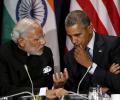
'Big countries do not agree on every set of issues.' 'Look, one of the differences in the relationship is that when we do not agree, we are sitting down and talking to each other.'

The beauty of the relationship between the two countries is that they agree to disagree and perhaps that is the strongest bond between the two governments and their relationships, notes Rup Narayan Das.

United States Secretary of State John Kerry on Monday said both India and United States have invested in the relationship and will continue to deepen it by creating a healthier, more secure and prosperous future to be able to impact policies that affect the world.

'By the time he came out after nearly five hours, he had a one-to-one conversation with the President, a delegation-level meeting, a reception, a dinner, a tour of the White House and a joint statement of a kind none of his predecessors ever had,' says Ambassador T P Sreenivasan.
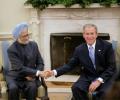
'The nuclear deal required Prime Minister Manmohan Singh to gamble the future of his government on a vision for the future of his nation.'

'India's specific concerns about whether Russia will be a reliable defense supplier and diplomatic partner in the event of heightened hostilities with China has undoubtedly accelerated the process of US-India defense and intelligence cooperation intended to support Indian military positions along the Line of Actual Control.'
 © 2026 Rediff.com - Advertise with us - Disclaimer - Privacy Policy - Sitemap - Feedback - About us - Terms of use - Grievances